
The Nigerian Navy has inducted KALI 3, the third commissioned of 10 Security Support Vessels being provided by Sterling Oil Exploration and Energy Production Company Limited (SEEPCO), in a development that highlights the growing intersection of maritime security, energy security, cleaner mobility and indigenous shipbuilding capacity in Nigeria.
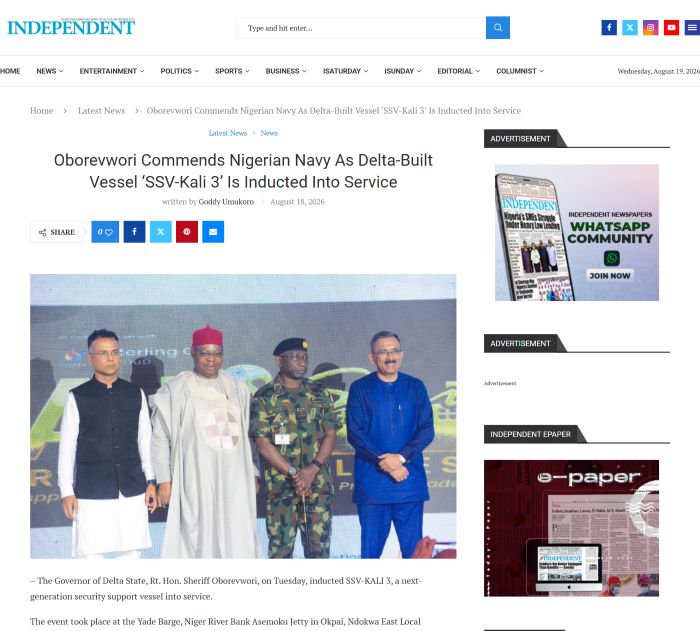
The vessel was formally commissioned at Asemoku Jetty, Delta State, on Tuesday, 18 August 2026, with Chief of Naval Staff (CNS), Vice Admiral Idi Abbas, presiding over the ceremony which was attended by senior military officers, government officials, traditional rulers, maritime stakeholders and representatives of the private sector. KALI 3, comparable to other was designed and built locally at the Okpai HM Shipyard in Delta State, in collaboration with the Nigerian Navy.
The vessel is the first of 10 Security Support Vessels being delivered to the Nigerian Navy under a Memorandum of Agreement with SEEPCO. Two others have been commissioned previously and already in operation. It is designed to support coastal and offshore security operations, including maritime law enforcement, interdiction, anti-piracy operations and the escort of critical energy assets such as crude oil tankers, LNG carriers and offshore supply vessels.
Its induction therefore goes beyond the addition of another security platform to the Navy’s fleet. It places renewed attention on the capacity of Nigerian companies and institutions to develop maritime assets locally while strengthening the security infrastructure supporting the country’s energy economy.
Built for Nigeria’s challenging coastal environment, KALI 3 is designed for operations in shallow waters and creeks and incorporates surveillance, navigation and communication systems intended to support extended maritime missions.
More significantly, the vessel forms part of a wider pattern in SEEPCO’s engagement with strategic public institutions, one that includes support for CNG-powered public-sector mobility and the development of LNG transportation infrastructure.
Taken together, these interventions raise a broader question about the evolving role of energy companies in Nigeria: whether their contribution to national development can move beyond the production of energy to include the infrastructure, mobility systems, maritime capabilities and institutional partnerships required to secure, transport and deploy energy more efficiently and sustainably.
That is where the significance of KALI 3 begins to extend beyond the commissioning ceremony.